|
Back
An Anniversary Cast in Mahlerian Bronze Montreal
Salle Claude-Champagne
11/07/2026 -
Guillaume Lekeu: Adagio
Edvard Grieg: Holberg Suite, op. 40
Gustav Mahler: Symphony No. 1 in D major
Sinfonia de Montréal, Louis Lavigueur (conductor)
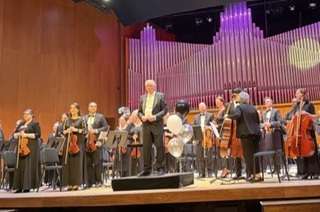
(© Ossama el Naggar)
The twenty-fifth anniversary of Sinfonia de Montréal was celebrated on Saturday, November 7, with a programme that paid tribute both to the orchestra’s origins and to the artistic ambitions it has pursued over a quarter‑century. Under the direction of its founder, Louis Lavigueur, the ensemble offered a commendable performance of three works of markedly different character, culminating in Mahler’s First Symphony. Particularly gratifying was the presence of several musicians who had participated in the orchestra’s inaugural performance in 2001, at Eglise Saint-Jean-Baptiste, when Sinfonia de Montréal was still essentially a string orchestra. Their continued association with Lavigueur is a testament to the loyalty and musical camaraderie that have sustained this Montreal institution.
The evening opened with Guillaume Lekeu’s Adagio, composed in 1891, in the aftermath of the death of César Franck, whose influence had been decisive in the young Belgian composer’s musical formation. Franck had died in November 1890, leaving Lekeu bereft of a revered teacher and artistic mentor. The Adagio, with its expansive melodic lines, harmonic richness and elegiac character, belongs unmistakably to the late‑Romantic world of Franck and his disciples. Its inclusion was particularly appropriate for an anniversary concert devoted in part to the orchestra’s string‑playing origins. Its sombre eloquence also seemed consonant with the approaching Remembrance Day commemorations of November 11. From the opening measures, the orchestra produced a warm, richly textured sonority, with a commendable equilibrium between the upper and lower strings. The performance conveyed the work’s melancholy without lapsing into excessive sentimentality.
Edvard Grieg’s Holberg Suite followed. Written in 1884 to commemorate the bicentenary of the birth of the Norwegian-Danish playwright Ludvig Holberg (1684‑1754), the suite was conceived as a musical evocation of the eighteenth century. Its five movements, fashioned in a neo‑Baroque idiom, nevertheless bear the unmistakable stamp of Grieg’s Romantic sensibility. The work’s inclusion offered a particularly felicitous anniversary parallel: just as Grieg had fashioned a musical tribute to an earlier cultural epoch, Sinfonia de Montréal was celebrating the continuity of its own artistic enterprise. The suite was performed with panache and considerable energy. Despite its frequent appearance in concert programmes, it remains a work whose charm is difficult to exhaust. A minor mishap involving the repetition of a passage in one of the concluding movements briefly unsettled the ensemble, but the musicians recovered their footing and delivered a spirited finale.
The second half belonged to Gustav Mahler’s First Symphony, a work whose compositional history is almost as fascinating as the music itself. Initially conceived in the late 1880s as a symphonic poem in two parts, it was presented in Hamburg in 1893 under the title Titan, accompanied by programmatic explanations and descriptive titles for its movements. Mahler subsequently withdrew these indications, removed the movement known as Blumine, and revised the work into the four‑movement symphony familiar today. Yet the narrative and autobiographical dimensions of the original conception remain deeply embedded in the score. The symphony traces a passage from an awakening natural world and youthful innocence, through the irony and grotesquerie of the funeral march, towards the cataclysmic struggle and eventual triumph of the finale. Its extraordinary diversity of expression, oscillating between the pastoral and the grotesque, the tender and the bombastic, makes it a work that demands not merely technical command but a thorough understanding of Mahler’s singular musical imagination.
The performance proved a veritable showcase for the orchestra. Augmented by additional percussion and harp, the ensemble rose admirably to the considerable demands of the score. There is, arguably, a particular affinity between Mahler’s music and a conductor who has accumulated the experience of a long musical life. Its alternations of innocence, irony, anguish and hard‑won affirmation require an understanding of human contradictions that cannot always be acquired through technical proficiency alone. Now in his eighth decade, Lavigueur demonstrated a convincing affinity for this music, approaching its many contrasts with evident familiarity and interpretative conviction.
The third movement was especially memorable. Its solemn, almost funereal introduction, built around the familiar minor‑mode transformation of the children’s song Frère Jacques, established an atmosphere of unsettling introspection. The ensuing pastoral trio, in which the woodwinds were particularly effective, offered a moment of respite before the music turned towards the brusque, almost caricatural character of a Bohemian dance. The movement’s extraordinary juxtaposition of the macabre and the rustic was well conveyed, as was its eventual retreat into an unresolved quietude.
A thunderous cymbal crash heralded the fourth movement, plunging the listener into the violent and tumultuous world of Mahler’s finale. Here, the orchestra demonstrated its capacity for considerable sonic force without altogether sacrificing musicality. The French horns were particularly impressive, their contribution lending the climactic passages both brilliance and grandeur. The trumpets, trombones and percussion were equally noteworthy. The lower strings, meanwhile, distinguished themselves not only in the more agitated passages but also in the achingly beautiful pizzicato writing of the waltz‑like episodes. These moments, in particular, revealed the ensemble’s capacity for delicacy and refinement.
The finale is a formidable test of orchestral cohesion, with its competing thematic strands and successive surges of instrumental intensity. The various sections seemed at times to vie for supremacy, yet the resulting accumulation of energy was exhilarating. As Mahler finally turned towards the major mode and the symphony’s affirmative conclusion, there was an almost palpable sense of collective release among the musicians. Their jubilant response to the final chords was entirely understandable, and the audience rewarded the performance with prolonged and thunderous applause.
The achievement was not without reservations. At certain moments, the strings appeared insufficiently synchronized, and their sonority occasionally lacked the weight one would have wished for in a work of such orchestral proportions. There were also instances in which the wind players did not respond with complete precision to the conductor’s cues. These shortcomings, while noticeable, did not fundamentally compromise the overall performance. Indeed, the orchestra’s evident familiarity with one another, and the affinities developed through years of shared music‑making, were among its most appealing attributes. The ensemble displayed a commendable ability to negotiate the work’s formidable technical and expressive demands, even if a greater degree of precision would have further enhanced the result.
An ambitious programme such as this, moving from Lekeu’s intimate string elegy through Grieg’s neo‑Baroque refinement to the immense emotional and orchestral architecture of Mahler, required considerable dedication from both conductor and musicians. Sinfonia de Montréal acquitted itself with distinction. The anniversary was thus more than a commemorative occasion: it provided a persuasive demonstration of the orchestra’s continuing artistic vitality and of Louis Lavigueur’s enduring commitment to its development. The warm reception accorded to the musicians was richly deserved. After twenty‑five years, Sinfonia de Montréal remains a valued component of the city’s musical life, sustained by the dedication of its founder and the loyalty of the musicians who have accompanied him on this remarkable journey.
Ossama el Naggar
|
