|
Back
Sex, Drugs and Rock'n Voices New York
Fisher Center, Bard College
07/24/2026 - July 26, 29,31, August 2, 2026
Richard Strauss: The Egyptian Helen (Die ägyptische Helena); Libretto by Hugo von Hofmannsthal (From the drama of
Helena (Hailey Clark); Menelaus (John Matthew Myers); Aithra (Jana McIntyre); Altair (Blake Denson); An Omniscient Seashell or Conch (Deborah Nansteel); Hermione (Cecilia Popp/Keya Upadhyaya); Alair (Blake Dawson); Da-Ud (Shawn Roth); Two servants of Althra (Catherine Creedl, Deborah Mansteel); Four Elves Holly Thomas, Mary Burke Barber, Hai Ting Chinn, Alison Gish; James Bagwell (Chorus Master), Bard Festival Chorale;
Catherine Galasso (with dancers) (Choreography); Daniel Unger (Scenic Design); Mattie Ulrich (Costume Design); Tyler Micoleau (Lighting Design); Christian Räth (Director); Leon Botstein (Conductor), American Symphony Orchestra
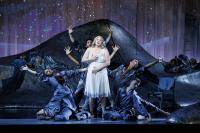
H.Clark with cast(©Maria Baranova)
”My music is melodious, beautiful, and unfortunately presents no problems to ears developed beyond the 19th century.”
Richard Strauss before the 1922 premiere of Helen in Egypt
”Oh, how I wish I could rub my beauty out like a picture, and assume hereafter in its stead a form less comely. This is the doom and depth of my despair: the very beauty that makes other women happy has proved for me a blasting curse.".
Euripides, Helen
The weirdness of Leon Botstein’s latest production, Richard Strauss’ rare tenth opera, is pure tautology. All opera, by its character is weird. Yet what other opera than I>Helen in Egypt has a talking seashell? A fridge loaded with drugs? A heroine who is part Homeric, part Hollywood. And to her husband,
All Living in a land which neither Homer or Christopher Nolan ever imagined, part Egyptian, part Greece., And in this production props encompassing Trojan swords, Hellenic knives, that modern refrigerator, a tiny nuptial bed transformed into a Gargantuan nuptial bed? A horde of papparrazi, complete with flash-cameras, posters announcing eponymous heroine, surrounded by swarms of soldiers, lovers, phantoms, and elves, all waving their arms like daffodils in a tornado.
In Baroque musical nomenclature, Bard’s Summerscape opera was stylo misto–-a mixed style.
Part might be the fault of the two creators. Richard Strauss wanted a frothy musical comedy like Offenbach’s La Belle Helene. The aging Hugo von Hofmannsthal, a deep scholar of Classical Greek and Latin, was not inclined for humor even in myths. Besides, he knew that both Herodotus and Euripides placed Helen neither in Troy nor Sparta, but in Egypt.
The result personified W.H. Auden’s "No good opera plot can be sensible, for people do not sing when they are feeling sensible.”
Add to that Richard Strauss’ act of pure revenge. In the first act, the two main sopranos sing endlessly on high A, B and C, rarely coming down to earth. Since the second act here was staged at Bard like a potpourri of Salvatore Dali, Max Reinhardt and Mel Brooks, one paid little attention to the singing.
The original plot is a mess. Melenaus, originally Helen’s husband, wants to kill her for being.... er, a rather naughty girl during the Trojan War. So he has killed her. No,(apologies) he killed a phantom of Helem created by a sorceress (That is offstage, as well as Helen’s birth being hatched from an egg.
(Stick with me: this is only the start.)
After that, with the real Helen is still around, Menelaus (a very confused hero) finds he doesn’t love the aging Helen even when sge is real, and her child shows up. Even more confusing, the daughter of an Egyptian king (Mia Pharaoh?) tries to help Helen with a bewildering series of drugs, potions, and other stuff which she pulls from an Act II refrigerator.
Act I in this production is relatively coherent and serious. Act II is silly, extravagant, a confusion of mirrors, marching Trojans, vicious sheiks, infinite scenic background and costumed supernumeraries and an endless felicitous Gotterdamrung finale with a happy ending.
Don’t ask.
So we go back to the music. The American Symphony Orchestra was saddled with–-and rode gallantly under Leon Botstein’s direction–all the brilliant brassy effects which Strauss could muster up. After ten operas (including several of Greek mythology), the composer was not afraid of Heldenleben battles or Salome passion.
Perhaps Strauss’s orchestra needed more charm or subtlety. That was rare. That the pit orchestra was too soft for the voices was a shame but understood. When they blazed out their fanfares and romantic chorales, the ASO was terrific.
To his equal credit, Mr. Botstein chose singers who went through their demanding notes not only with aplomb but frequent glory. If one felt the Act I high notes of were often endless, one had only the greatest admiration for Hailey Clark’s Helena or Jana McIntyre as the helpful frustrated Egyptian princess.
Helped by a contralto seashell (sic), well sung by Deborah Nansteel.
In fact, these were the only interesting characters, and their acting in that Act II circus was admirable. Menelaus is hardly a hero, but those rare times the tenor John Matthews could rise to the occasion, like the post-love-making scene, he was fine. As was the stunning effortless baritone of Blake Denison.
My favorite? Keya Upadhyaya as the child, rushing to her parents with bona fide sincerity.
And while I felt the staging, singing of elves, slaves, Trojans and other costume-changing chorus, the effects were too sporadic and sudden for comprehension, But they seemed right.
After this two-hour Egyptian excess, I asked some glassy-eyed spectators how they liked it. They loved it. They felt that opera should have such fantasy. I saw their point. And in my libretto (I’d never heard the opera before), both the German and the English translation were ravishing.
That the director, costume designer and other technicians should choose to make a quasi-chamber opera into a colorful carnival was their choice. I prefer leaving hallucinogenic scenery to the Egyptian narcotics, and letting Richard Strauss’ voices and orchestra sing for themselves.
Harry Rolnick
|
