|
Back
A Very British Yuletide at La Scala Milano
Teatro alla Scala
12/15/2025 - & December 10 (Paris), 14 (Roma), 16 (London), 2025
George Frideric Handel : Messiah, HWV 56
Ana Vieira Leite (soprano), Sarah Connolly (mezzo), Andrew Staples (tenor), William Thomas (bass)
The Monteverdi Choir, English Baroque Soloists, Christophe Rousset (Conductor)
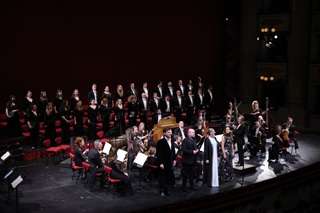
(© Brescia e Amisano/Teatro alla Scala)
For music lovers in the Anglosphere, Handel’s Messiah is synonymous with Christmas festivities. This is not necessarily the case elsewhere. Therefore it was surprising to see this monumental oratorio programmed as part of La Scala’s “Guest Orchestra” series. Not surprisingly, a healthy contingent of the audience were British and American expats. For once, English was more widely heard than Russian, French or German. However, a good deal of the audience were lovers of early music, purveyors of which are conductor Christophe Rousset, the Monteverdi Choir and the English Baroque soloists.
Established by John Eliot Gardiner in 1964 and 1968 respectively, the two revered British ensembles are especially admired for their performances of Bach and Handel. French harpsichordist/conductor Christophe Rousset, founder of the French early music ensemble Les Talens Lyriques and a Lully specialist, has been their leader since 2024. Their collaboration has been a felicitous one, as manifested in this performance, characterised by elegance and sobriety.
Created on the occasion of Lent in 1742 in Dublin, Handel’s Messiah is most associated with Easter, but it’s increasingly become a cornerstone of musical life at Christmas in English-speaking countries. The version performed at La Scala is the London version from 1752.
The four voices chosen were uniformly excellent performers. Portuguese soprano Ana Vieira Leite is a light lyric soprano specializing in the baroque repertoire. Her crystalline timbre is brilliant, and despite its relatively small size, her voice can easily soar, as it often did in this performance. The purity of her voice is her trademark, and this quality rendered the interpretation of her arias more ethereal and moving.
British mezzo Sarah Connolly is a remarkable singer in the lineage of the great Janet Baker. She’s a truly phenomenal interpreter, with perfect diction in any language, overwhelming stage presence and above all, endless expressivity. The latter was definitely a big plus in this performance, though one would have preferred a contralto in this part. Nonetheless, thanks to Rousset’s mastery, the imbalance was not as noticeable as it might have been in the hands of a lesser conductor.
British tenor Andrew Staples, previously admired as Florestan in Fidelio in Barcelona, and as Bacchus in Ariadne auf Naxos in Vicenza, was an excellent choice as the oratorio’s tenor voice. Endowed with a gorgeous, hefty lyric tenor as well as admirable diction, Staples stood out. Thanks to Rousset’s masterful conducting, all soloists were kept in check and no one, not even this wonderful tenor, stole the show.
William Thomas, the British bass recently heard in the minor role of Colline in La bohème in Munich opposite superstars Pene Pati, Angel Blue and Mattia Olivieri, managed to stand out thanks to his beautiful timbre and excellent delivery.
The balance between the orchestra and the vocal forces was perfect, perhaps the strongest aspect of this performance. By avoiding the dominance of voices over music, despite having four of the best soloists I’ve ever heard in this work, Rousset did not succumb to the common pitfall wherein the sacred work becomes operatic, tempting, given this venue and its storied history.
Possibly the most impressive element of the performance was the Monteverdi Choir who are unrivalled in this repertoire. Again, Rousset was as adept a chorus master as he was conductor, leading the choir in a vibrant performance, eschewing unnecessary exuberance, even for such cherished passages such as the famous “Hallelujah Chorus.” The restraint rendered the overall performance much stronger. There’s a reason why this work survives today; its structure is infallible.
In a recent interview, Rousset stated these British ensembles are planning to record and perform Handel’s other oratorios (these number a staggering twenty‑seven!). This is a delightful prospect indeed.
Ossama el Naggar
|
