|
Back
Charpentier’s Musical Treasure-Box New York
Howard Gilman Opera House, Brooklyn Academy of Music
12/05/2025 - & December 6, 7, 2025
Marc-Antoine Charpentier: Pastorale sur la Naissance de Notre Seigneur Jésus-Christ, H.483 – Messe de minuit à 4 voix, flûtes et violons, pour Noël, H.9
Emmanuelle de Negri (Soprano), Bastien Rimondi (Tenor), Alex Rosen (Bass)
Les Arts Florissants, William Christie (Founder, Musical Director, Conductor)
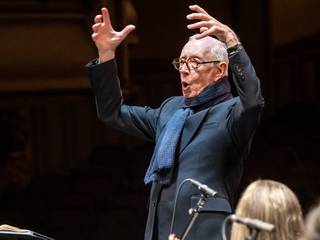
W. Christie (© Richard Termine)
“Baroque music is a celebration of the beauty and diversity of the human experience.”
William Christie
“How greatly did I weep in thy hymns and canticles, deeply moved by the voices of thy sweet‑speaking church.”
St. Augustine
Had not the vile jealous Italian Jean-Baptiste Lully keep Charpentier away from Louis XIV, we would almost be singing the French composer’s magnificats as the most important composer of the French Baroque. (I say “almost” because nobody reading this should start singing after Les Arts Florissants.)
Last night, William Christie (certainly the most important conductor of the French Baroque) offered, in two works, proof that Charpentier’s excellence encompassed, not a single note of respect, but a multitude of creative rejoicings.
In the opening Pastorale for the Birth of Our Lord Jesus Christ, he had a full three‑act drama. His music echoed the splendid non‑Biblical words of pathos, prediction, prayers of shepherds, and the oh‑so lovely adorations for the Baby Jesus and the chaste Virgin Mary.
He needed no Amens or Hosannas. Instead he had musical interludes of strings, keyboard, “rustic flutes” (actually recorders) and three light taps of a bell. Mr. Christie led soprano Emmanuelle de Negri with tones not operatic, not even Handelian, but with a sweetness echoed by the 20‑voiced Les Arts Florissants.
The almost-fugal final chorus of shepherds after the calm praise of the mother of Jesus was oh so beautifully handled by the full chorus. After all, didn’t need a whole Handel style fugue. Charpentier was working for the adoration, the magical and probably incense‑filled church for a secular aristocrat. He hardly needed to show off his technical virtuosity.

W. Christie, E. de Negri, Les Arts Florissants (© Richard Termine)
Which leads to the kind of caveat through which only pedants would suffer. Somewhere conductor Christie said, “historically informed performance must be combined with personal artistic expression.” And that knowledge of Baroque music doesn’t mean to “ossify” the performance.
Thus Charpentier’s call for eight solo voices was transformed into the grand chamber chorus of Les Arts Florissants. Thus, the composer’s ensemble of vocal soloists, two flutes, two violins, and of course continuo bass in the Midnight Mass was transformed into the whole Les Arts Florissants orchestra and chorus.
To which (if that Midnight Mass hadn’t already said it,) one must repeat “Hosanna.”
The opening Pastorale was so dramatic, such a wealth of male‑female soloists, such sudden (not sporadic) changes from pathos to queries to finally the joy of birth, that one was immediately transfixed–and also flummoxed!
Who wrote that brilliant libretto in 1684? In the 20th Century, we know that the religious Paul Claudel wrote Honegger’s Christmas Oratorio, or that Menotti wrote his own Amahl words.
But this masterpiece of humanity embracing the savior of humankind is lost.

M.-A. Charpentier (From Pierre Landry’s “Almanach Royale,” 1682)
After the intermission came the jolliest Catholic Mass I’ve ever heard. I had an old recording of the work, but never associated it with anything spiritual. Nor did Charpentier stick with the liturgical rules.
Luther and the Lutherans had marked out the sober, mournful chorale stuff up in Germany. But Charpentier, who studied in tuneful Italy, was hardly averse to writing a Mass with ten merry Christmas tunes.
The Kyrie was a jumping choral tune repeated at the end. Even the Credo was danceable enough for Louis XIV, had he heard it.
Yes, there were a few moments of religion in the “Amen.” (The BAM audience was forgiven for starting to applaud), but otherwise, the songs could have fit an Elizabethan comedy.
When finished, after two encores, William Christie, who founded his group almost 50 years ago and transformed them into icon of choral-orchestral miracles, stood first in front of the group, then went to the back to stand alongside that chorus.
Walking back to the subway, I suddenly remembered being taken to the Met Museum as a six‑year‑child. Seeing my first Raphael, I asked my mother whether angels were real.
I forgot her answer, but listening to Charpentier last night, at least I finally know the notes for which Raphael’s angels make an eternal joyful noise.
Harry Rolnick
|
